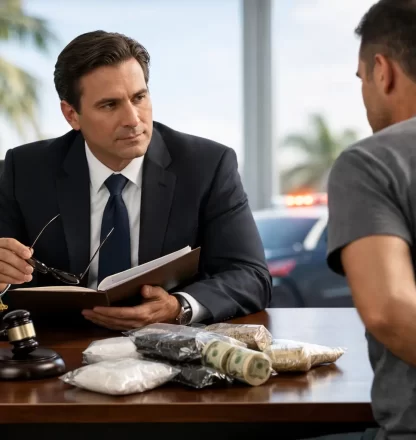
A trafficking charge changes the temperature of your life fast. One arrest can put your freedom, job, license, reputation, and family stability on the line at the same time. If you are looking for a drug trafficking defense lawyer Florida residents can call when the stakes are this high, you are not looking for hand-holding. You are looking for someone ready to attack the state’s case.
Florida treats drug trafficking as a serious felony, and prosecutors do not file these charges casually. In many cases, they come loaded with mandatory minimum prison exposure, steep fines, asset seizure risks, and aggressive pressure from law enforcement to get statements, consent, or cooperation. That means the first moves matter. What you say, what you hand over, and whether your lawyer starts dissecting the case immediately can shape the entire fight.
What a drug trafficking charge means in Florida
Many people hear the word trafficking and assume it means crossing state lines or running a large operation. That is not how Florida law works. In many cases, trafficking charges are based on weight, not proof of a sophisticated distribution network. If the state claims you knowingly sold, purchased, manufactured, delivered, brought into Florida, or possessed a certain quantity of a controlled substance, prosecutors may pursue trafficking charges even if there is no evidence of a cartel-style operation.
That is one reason these cases hit so hard. A person can go from thinking they are facing simple possession to confronting a first-degree felony or another major felony charge with mandatory prison time attached. The difference often comes down to the type of substance, the alleged amount, and the way police describe the facts in their reports.
This is where precision matters. The state has to prove the substance, the weight, possession or control, and the required knowledge under the law. Those may sound straightforward on paper. In the courtroom, they are often full of cracks.
Why you need a drug trafficking defense lawyer in Florida early
A drug trafficking defense lawyer in Florida does more than appear at hearings. In a strong defense, counsel starts testing the foundation of the case from day one. Was the traffic stop lawful? Was the search valid? Did police exceed the scope of consent? Was there probable cause for a vehicle search, a home search, or a warrant application? Was the alleged substance properly tested and weighed? Did officers push for statements after your right to remain silent should have ended the conversation?
Waiting is dangerous because prosecutors and police are already building their narrative. They will frame the stop, the seizure, the statements, and the chain of custody in a way that supports conviction. A passive response invites the state to control the story. A disciplined defense pushes back early, preserves evidence, and forces the prosecution to prove every inch of its case.
That matters in Florida because trafficking cases are often built on drug interdiction stops, confidential informants, controlled buys, search warrants, codefendant finger-pointing, and lab analysis. Each of those moving parts creates potential weaknesses. It also creates opportunities for a serious defense lawyer to challenge credibility, expose shortcuts, and pressure the prosecution where the case is vulnerable.
The state has the burden – and that burden is heavy
The prosecution may act as if an arrest settles everything. It does not. A charge is an accusation, not a conviction. In a trafficking case, the government still has to prove guilt beyond a reasonable doubt.
That burden gets harder for the state when the evidence is messier than the charging document suggests. Constructive possession cases are a good example. If drugs were found in a shared vehicle, a home with multiple occupants, or an area several people could access, the question becomes more complicated. The state must connect the accused person to the drugs in a legally sufficient way. Mere proximity is not enough.
The same is true with statements. People under pressure say things they do not mean clearly, agree with officers to end a confrontation, or make admissions after a confusing roadside encounter. Context matters. Tone matters. Whether Miranda warnings were required matters. A defense lawyer should be ready to dissect every line the state wants to use.
Common defense angles in trafficking cases
There is no universal defense that fits every trafficking arrest. These cases turn on details. Still, several battle lines come up often.
Illegal stop or illegal search
If police had no lawful reason to stop a car, extend a detention, search a vehicle, enter a home, or seize property, key evidence may be subject to suppression. If the drugs come out, the case can collapse or weaken dramatically.
Lack of possession or control
The state must prove more than presence near contraband. In shared spaces, borrowed cars, or homes with multiple occupants, possession can be a real fight.
Lab and weight challenges
Trafficking charges often rise or fall based on weight thresholds. That makes testing procedures, packaging, contamination, and measurement methods important. If the state cannot prove the necessary weight, the trafficking charge itself may be vulnerable.
Informant credibility and police procedure
Cases built through informants, controlled buys, or surveillance deserve aggressive scrutiny. Informants may have motives to lie. Officers may overstate certainty or leave out facts that hurt their narrative.
Knowledge and intent issues
It depends on the facts, but the state may still need to prove that the accused knew about the substance and its presence. That can become a major issue when drugs are hidden, transferred by another person, or found in a location the defendant did not exclusively control.
Mandatory minimums raise the pressure
One reason these cases demand a fighter is the leverage mandatory minimum sentencing gives prosecutors. When a trafficking count carries a mandatory prison term, the pressure to plead can become intense. People get scared. Families panic. Employers start asking questions. Prosecutors know that fear can move cases.
But pressure is not proof.
A strong defense attorney does not treat mandatory minimum exposure as a reason to fold. It is a reason to investigate harder, challenge harder, and negotiate from a position of strength rather than panic. Sometimes the right move is an all-out attack on the admissibility of evidence. Sometimes it is exposing evidentiary weakness to force a charge reduction. Sometimes it is preparing for trial because the state’s version does not survive real scrutiny. The answer depends on the facts, the evidence, the judge, and the risks. What should never happen is sleepwalking into a result because the charge sounds intimidating.
What to do after a trafficking arrest
If you have been arrested or believe you are under investigation, act like every word matters because it does. Do not try to explain your way out. Do not consent to extra searches. Do not call alleged codefendants to compare stories. Do not assume police are just gathering background information. They are building evidence.
Your job is to protect yourself. Ask for a lawyer. Stay off social media. Preserve anything that may help your defense, including messages, location data, receipts, and names of witnesses. Then get counsel involved quickly enough to review reports, body camera footage, warrant materials, lab records, and the timeline before the state hardens its position.
What a strong trafficking defense should look like
A real defense is not a stack of continuances and vague reassurances. It is strategic pressure. That means filing targeted motions, forcing discovery, exposing contradictions, challenging weak warrants, testing chain of custody, and cross-examining officers with purpose.
The courtroom matters here. A trafficking case can turn on whether the defense lawyer is willing and able to confront police testimony directly, not just recite legal standards politely. Judges and prosecutors pay attention to which lawyers are prepared to fight over facts, credibility, and procedure. In serious felony cases, that reputation matters.
At The Law Offices of Julian M. Kessel, that posture is direct and unapologetic. When the state tries to box a client into a damaging narrative, the defense should hit back with discipline, force, and a clear theory of the case.
Choosing a drug trafficking defense lawyer Florida defendants can trust
Not every criminal defense lawyer approaches trafficking cases with the same level of urgency or aggression. Some focus on case processing. Others prepare for impact. When you are choosing a drug trafficking defense lawyer Florida courts will take seriously, look for someone who understands felony practice, handles high-exposure drug cases, and is ready to challenge the prosecution rather than orbit around it.
You also want clarity. You should understand the charge, the sentencing exposure, the likely pressure points, and the possible defense paths without needing a translator. Good defense is not theatrical noise. It is command of the facts, command of the law, and the willingness to put the state under stress.
If you are facing a trafficking allegation, this is not the time for hesitation or false comfort. Get a lawyer who treats the case like what it is – a fight for your future, and one that starts now.