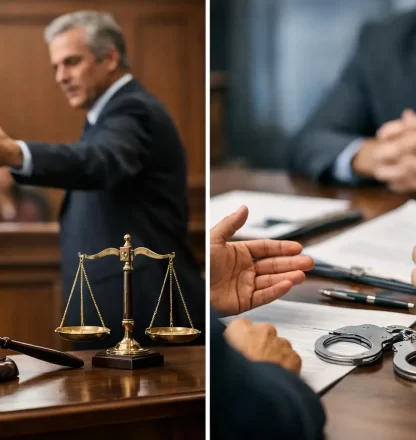
The first offer from the prosecution can feel like a trap disguised as relief. You are scared, your family wants this over, and the state is counting on pressure to do part of its work. That is where the trial lawyer vs plea deal question becomes real. It is not a slogan. It is a strategic fork in the road that can affect your freedom, your record, your job, your license, and your future.
A lot of people assume the choice is simple. If a plea deal is on the table, take it. If you are innocent, go to trial. Real criminal defense does not work that way. Cases are won and lost in the gray areas – in witness credibility, police mistakes, weak forensic claims, bad searches, inconsistent statements, overcharged allegations, and the prosecutor’s fear of getting exposed in court.
Trial lawyer vs plea deal is really a leverage question
A plea deal is not automatically a bad result. A trial is not automatically the brave result. The real issue is leverage. Who has it, who built it, and who knows how to use it.
A strong trial lawyer changes the entire negotiation. Prosecutors pay attention when they know defense counsel will attack the case, cross-examine aggressively, file motions, expose weak evidence, and force the state to prove every inch of its story. That pressure matters. It can lead to reduced charges, better sentencing terms, diversion options, or outright dismissal opportunities that would never appear if the defense comes in soft.
On the other hand, if the evidence is overwhelming and the risks of trial are severe, a plea deal may be the smart move. Smart is not the same as passive. A disciplined defense lawyer does not accept the state’s first version of events and call it strategy. He tests the evidence, measures the risk, and decides whether to strike or negotiate from strength.
When a plea deal makes sense
Some clients hear the word plea and think surrender. That is not always true. In the right case, a plea can be damage control with purpose.
If the state has strong evidence, such as a valid confession, reliable surveillance, forensic support, and credible witnesses, trial risk goes up fast. The same is true when mandatory minimums, prison exposure, immigration consequences, or felony enhancements are on the table. In those situations, reducing the charge or controlling the sentence may be the move that protects the client from a far worse outcome.
A plea may also make sense when the client has personal goals that matter as much as the legal fight. Some people need to protect a professional license, avoid jail so they can keep working, preserve immigration options, or resolve a case quickly to stabilize family life. Good defense strategy takes the whole person into account, not just the courtroom chessboard.
But there is a condition. The plea has to be informed. That means knowing the evidence, understanding the defenses, seeing the sentencing exposure clearly, and weighing collateral consequences honestly. Taking a deal because you are panicking is not strategy. It is surrender under pressure.
A bad plea can do long-term damage
People focus on the short-term relief of ending the case. They should also think about what follows them after court. A conviction can affect employment, housing, firearm rights, professional discipline, driver’s license status, reputation, and future sentencing if there is another arrest later.
That is why the words on the paperwork matter. Whether the charge is reduced matters. Whether adjudication is withheld matters. Whether jail is avoided matters. Whether the plea closes the door on future options matters. A hard-nosed defense lawyer looks at the entire blast radius, not just the immediate courtroom result.
When a trial lawyer is the right answer
Some cases need a courtroom fighter, not a deal broker. If the prosecution’s case is weak, inconsistent, inflated, or built on questionable police work, trial pressure can expose it.
This happens more often than people think. Witnesses change stories. Officers make assumptions. Informants have motives. Search and seizure issues poison the evidence. Lab results are not always as clean as the state pretends. In violent crime cases, self-defense, identity, and intent can become major battlegrounds. In DUI and drug cases, procedure can make or break the prosecution.
A real trial lawyer is not valuable only when the jury is sworn in. He is valuable early, because his reputation for going to war affects every stage of the case. Prosecutors are more careful when they know sloppy work will get punished in motion practice and cross-examination. That alone can change plea offers and case posture.
Trial is a weapon, not a performance
Too many people think trial work is about charisma. It is not. Trial work is disciplined combat. It is preparation, timing, pressure, and control.
A serious trial lawyer studies the reports for cracks, lines up impeachment points, attacks witness credibility, challenges the admissibility of evidence, and forces the state to prove what it often assumes it can merely allege. He does not wander into trial hoping for magic. He builds a case that can survive impact.
That matters even if the case never reaches a verdict. The stronger the trial posture, the stronger the bargaining position. In many criminal cases, the fight itself creates the opening for the best resolution.
The biggest factors in the trial lawyer vs plea deal decision
No honest lawyer should promise the same answer in every case. The right move depends on the facts, the stakes, and the available openings.
The strength of the evidence is the first factor. If the state can barely hold its theory together, trial becomes more attractive. If the evidence is tight and lawfully obtained, plea negotiations may carry more value.
The second factor is sentencing exposure. A defendant facing probation on one side and years in prison on the other is making a different decision than someone weighing two relatively modest outcomes. Risk tolerance matters, but it must be grounded in reality.
The third factor is the client. Some clients want to fight no matter what. Others want certainty. A good defense lawyer respects that, but does not let emotion make the call alone. The job is to give clear-eyed advice, not empty bravado.
The fourth factor is the prosecutor and the venue. Some prosecutors overcharge and then retreat when challenged. Others dig in. Some judges are more trial-tested than others. Local knowledge matters in Florida criminal court because personalities, patterns, and pressure points matter.
What you should demand from your defense lawyer
If you are deciding between trial and a plea, you need more than a lawyer who passes messages between you and the prosecutor. You need someone who can tell you where the state’s case is vulnerable, what motions can be filed, what trial exposure looks like, and what the plea really costs you.
Ask direct questions. What evidence is weak? What happens if we fight? What happens if we plead? Are there suppression issues? Is the charge inflated? What is the worst-case scenario? What is the likely scenario? If your lawyer cannot answer those questions with force and clarity, that is a problem.
At The Law Offices of Julian M. Kessel, the defense mindset is simple: pressure the prosecution, attack the weak points, and never confuse quick resolution with good resolution. That is the posture serious charges demand.
Do not let fear make the state’s case for it
The state has time, resources, and a system built to move cases fast. What it does not always have is a case that can survive a real fight. That is why fear is dangerous. Fear makes weak deals look reasonable. Fear makes people waive defenses they do not understand. Fear makes rushed choices permanent.
The better approach is controlled aggression. Review the evidence. Measure the trial risk. Test the prosecution’s story. Then decide whether the right move is to negotiate, attack, or take the fight all the way into court.
The best criminal defense decisions are not made from panic. They are made from strength, preparation, and a clear view of what is worth fighting for.