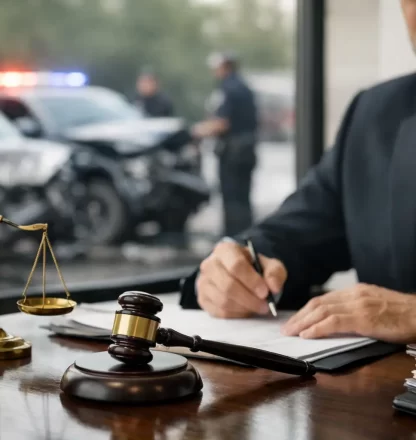
One crash. One death. A few words to police before you understand what happened. That is how a terrible night can turn into a felony prosecution. If you are searching for a vehicular manslaughter defense lawyer, you are not dealing with a routine traffic issue. You are facing a charge that can put your freedom, license, career, and name on the line.
This is the point where hesitation hurts. Prosecutors move fast in these cases because the facts sound powerful from the start. A person is dead. Officers have a crash scene, statements, body camera footage, bloodwork, phone data, and often a narrative they build within hours. But a charge is not a conviction, and emotion is not proof. Serious cases demand a defense that attacks the state’s theory at every pressure point.
What a vehicular manslaughter defense lawyer actually does
A strong defense begins with one hard truth: not every fatal crash is a crime. Florida prosecutors still have to prove the legal elements beyond a reasonable doubt. That sounds basic, but it is where real defense work lives.
A vehicular manslaughter defense lawyer does more than appear in court and negotiate. The job is to test every assumption behind the arrest. Was the driving truly criminally negligent, or was this a tragic accident? Did road conditions, weather, lighting, vehicle failure, or another driver play a major role? Was the timeline accurate? Were witnesses mistaken, inconsistent, or influenced by what they heard after the crash?
In a fatality case, the state often comes in with confidence. That confidence has to be challenged. A disciplined defense lawyer examines the crash reconstruction, medical evidence, toxicology, statements, electronic data, and officer conclusions for gaps, exaggerations, and shortcuts. If the prosecution built its case on shaky interpretation rather than hard proof, that weakness needs to be exposed early and relentlessly.
Why these charges are so dangerous in Florida
Vehicular manslaughter allegations carry obvious legal danger, but the damage reaches further than a prison sentence. Many people charged have never been in serious trouble before. They are stunned to learn how quickly their lives can start collapsing around the case.
A conviction can threaten incarceration, probation, license consequences, employment, professional licensing, immigration status, and civil exposure. Even before the case is resolved, the accusation alone can tear through a family, a business, or a reputation built over decades. That pressure causes people to make mistakes. They talk too much. They try to explain. They trust that being cooperative will make the case go away.
It usually does the opposite.
These cases are not won by hoping the prosecutor sees your side on their own. They are defended by forcing the state to prove every link in the chain.
The fight usually centers on fault, causation, and proof
Every vehicular homicide case turns on details, and details are where the defense has room to fight. The broad accusation may sound simple, but the legal battle rarely is.
Was the driving criminal or just a terrible mistake?
The state must do more than show a crash happened and someone died. In many cases, the real issue is whether the conduct rises to the level of criminal culpability. That line matters. A tragic accident is not automatically vehicular manslaughter.
Speed estimates can be wrong. Driver behavior can be misread. A split-second reaction can be painted as recklessness when it was actually panic, confusion, obstruction, or mechanical failure. Prosecutors often present the worst version of the facts. The defense must cut through that and force a more accurate picture.
Did the defendant’s actions actually cause the death?
Causation can become a major battlefield. Maybe another driver made the first dangerous move. Maybe the roadway design contributed. Maybe emergency response timing, medical complications, or an intervening event affected the outcome. The law does not allow the state to blur all of those issues into one emotional story.
This is where expert analysis can matter. Crash reconstruction is not guesswork. It involves measurements, physics, visibility studies, vehicle data, point of impact analysis, and timing. If the prosecution’s reconstruction is weak, incomplete, or overconfident, a strong defense can break it apart.
Is the state’s evidence as solid as it looks?
Fatal crash cases often come wrapped in supposedly scientific evidence. That does not mean the evidence is unassailable. Toxicology can raise chain-of-custody issues, interpretation problems, or timing disputes. Witnesses can be sincere and still wrong. Police reports can carry conclusions unsupported by what the officer actually observed.
Surveillance footage may help one side or the other, but even video has limits. Angles distort. Frames get missed. Distances look different on screen than they were in real time. A defense lawyer has to examine not just what the evidence shows, but what it does not show.
Early mistakes can make the case harder to defend
After a fatal crash, people are often in shock. They want to explain that they did not mean for anyone to die. They want officers to know they are not bad people. That instinct is human, but it can hand the state damaging admissions before the full facts are known.
Even statements that sound harmless can become prosecution tools. Saying “I only looked down for a second” or “I did not see them until it was too late” might be twisted into proof of criminal negligence. Apologizing can be framed as admitting fault. Guessing about speed, timing, or alcohol use can lock you into facts that later turn out to be inaccurate.
The same goes for phone records, social media, and private messages. Prosecutors look for anything that helps them build a story of recklessness. Silence is not weakness. It is protection.
Choosing the right vehicular manslaughter defense lawyer
Not every criminal defense attorney is built for a case like this. A fatal crash prosecution is not the place for passivity, delay, or timid lawyering. You need someone prepared to challenge the state’s experts, cross-examine aggressively, and pressure the prosecution where its case is vulnerable.
That does not mean empty theatrics. It means disciplined aggression. A serious defense lawyer should know how to read crash reports critically, work with defense experts, spot constitutional issues, and separate emotional force from legal proof. Sometimes the right move is a direct attack aimed at reduction or dismissal. Sometimes the smart move is strategic containment while the defense builds leverage. It depends on the facts, the evidence, the prosecutor, and the judge.
What should stay constant is posture. You want a lawyer who treats the case like a fight worth winning, not paperwork to be processed.
For clients in Wellington and surrounding Florida communities, that is exactly the kind of high-stakes criminal defense The Law Offices of Julian M. Kessel is built to deliver.
What the process often looks like
A lot of clients want to know whether the case will be resolved quickly. Sometimes it moves fast. More often, it should not. Rushed resolutions in serious felony cases can cost people years of freedom.
The early phase usually involves securing discovery, preserving evidence, reviewing statements, examining the scene, and identifying expert needs. Then comes motion practice, negotiation pressure, witness analysis, and preparation for the possibility of trial. If the state overcharged the case or cut corners in the investigation, those issues should be brought to the surface, not hidden in the file.
There is also a practical side to representation that matters. Clients need direct answers. They need to know what they are facing, what the strongest risks are, and where the opportunities may be. False comfort is useless. Clear strategy is what helps people make good decisions under pressure.
There may be defenses even when the facts look bad
This is one of the hardest things for frightened defendants and families to believe. They assume that because a death occurred, the outcome is already decided. It is not.
Some cases involve weak identification of the driver. Some involve flawed toxicology. Some turn on disputed speed calculations or incomplete crash reconstruction. Others involve medical causation questions, comparative fault, or evidence gathered in violation of constitutional protections. In still others, the conduct simply does not meet the threshold for the charge prosecutors filed.
None of that means every case disappears. It means good defense work starts from the facts, not from panic.
If you are facing this kind of accusation, do not measure your case by the police report or by what the arresting agency claims happened. Measure it by what the state can actually prove when every assumption is challenged, every witness is tested, and every weak point is put under pressure. That is where real defense begins.