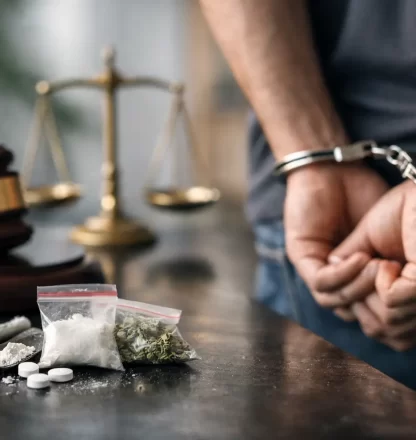
The question is usually asked in a panic, and for good reason. Can drug possession charges be dropped? Yes – sometimes they can. But they do not disappear because you explain yourself well, because it was a first offense, or because you hoped the prosecutor would show mercy. Charges get dropped when the state’s case is weak, the police cut corners, the evidence cannot hold up, or the defense drives enough pressure into the prosecution’s theory that continuing the case becomes risky.
That is the real battlefield. A drug possession case is not won by wishful thinking. It is won by exposing flaws, forcing answers, and making the state prove every inch of its case.
When can drug possession charges be dropped?
A possession charge can be dropped before trial, reduced through negotiation, dismissed after a successful motion, or fall apart because the prosecution cannot carry its burden. Which path applies depends on the facts. Two cases can look similar on paper and end very differently once the evidence is tested.
In Florida, the prosecution generally must prove more than the simple presence of drugs. It must show that the substance was illegal, that the accused knew it was there, and that the accused had control over it. If any one of those parts breaks, the case can weaken fast.
That matters most in constructive possession cases. If drugs were found in a shared car, a house with multiple occupants, or a borrowed backpack, the state may have a much harder time proving who actually knew about them and who had dominion or control. Prosecutors often file first and sort out the weaknesses later. A strong defense attacks those weaknesses early.
The fastest ways a possession case starts falling apart
The first pressure point is the stop. If police had no lawful basis to stop a car, detain a person, or prolong an investigation, everything that followed may be tainted. That includes statements, seized drugs, and any other evidence collected afterward. A bad stop can become a fatal problem for the state.
The next pressure point is the search. Police need lawful authority to search, whether that comes from consent, probable cause, a warrant, a valid arrest, or another recognized exception. If officers searched first and justified it later, the defense may be able to suppress the evidence. When the drugs get suppressed, the prosecution often has little left to stand on.
Then there is possession itself. Finding contraband near someone is not the same as proving legal possession. Drugs under a passenger seat, in a center console used by several people, or inside a residence with multiple adults present can create major proof problems. The state may try to bridge those gaps with assumptions. A defense lawyer’s job is to break those assumptions apart.
Lab testing can also become a serious issue. Prosecutors need admissible evidence that the substance was in fact an illegal drug. Problems with chain of custody, field testing, lab delays, or analyst testimony can all affect how strong the case really is. Sometimes the alleged drug is not what the arrest report claimed. Sometimes the paperwork is sloppy. Sloppy work matters.
Can drug possession charges be dropped if it is your first offense?
Sometimes, but a first arrest does not guarantee a break. People often assume prosecutors will simply let a first-time case go. That is not how criminal court works. A clean record helps, but it does not erase the charge.
What a first offense can do is create more room for strategic negotiation. In some cases, diversion, deferred prosecution, treatment-based resolutions, or reduced charges may be available. In others, the better move is not to rush into a program at all, especially if the case has legal defects that could support dismissal.
That is where experience matters. Taking the first offer on the table can be a mistake if the stop was unconstitutional or the possession theory is weak. On the other hand, rejecting a favorable alternative without understanding the risks can also backfire. Good defense is not blind aggression. It is targeted aggression.
The evidence the state must prove
Drug possession cases often sound simple until you look closely. The state usually has to prove knowledge, possession, and the identity of the substance. Each of those points can be attacked.
Knowledge means the prosecution must show you knew the drugs were there. If something was hidden, left by someone else, or found in a place multiple people could access, that can be a major problem for the state.
Possession means actual possession or constructive possession. Actual possession is easier for prosecutors when drugs are found on a person. Constructive possession is harder because it depends on control and awareness. Shared access creates doubt. So do inconsistent police reports and weak witness testimony.
Identity of the substance matters too. Officers may say they found cocaine, fentanyl, or pills without a prescription, but the state still has to prove that claim with admissible evidence. Arrest language is not proof.
Police statements can hurt – but they can also be challenged
Many possession cases become stronger for the prosecution because the accused talks. A person says, “Those are mine,” or “I was holding them for someone,” or even, “I forgot they were there.” One sentence can hand the state what it was struggling to prove.
But statements are not untouchable. If police questioned someone in custody without proper warnings, used coercive tactics, or produced a statement that does not match the body camera or reports, the defense may have grounds to challenge it. Even when a statement comes in, context matters. People under pressure say inaccurate things all the time.
Why motions matter in drug possession cases
A hard defense does not wait for trial and hope for a miracle. It files motions that force the court to examine police conduct and the prosecution’s proof. A motion to suppress can attack an unlawful stop, detention, or search. A motion to dismiss may be available in limited situations where the facts do not legally support the charge. Discovery demands can expose contradictions between officers, missing evidence, and weak links in the chain of custody.
This is where cases are often won before a jury is ever seated. Once a prosecutor sees key evidence is vulnerable, the balance of power can shift. Some cases get dropped because the state recognizes the damage. Others get reduced because trial suddenly looks dangerous.
Can drug possession charges be dropped in Florida after filing?
Yes. Filing charges is not the finish line. Prosecutors can still drop them later if the evidence weakens, a witness falls apart, a motion succeeds, or further review shows the case is not worth taking to trial.
That happens more often than people think, but not because the state becomes generous. It happens when the defense creates pressure. A prosecutor is less likely to walk away from a case that goes unchallenged. When the defense exposes unlawful police work, attacks possession, and makes trial riskier, dismissal becomes a more realistic outcome.
What can make dismissal less likely
Some facts make a case harder to knock out completely. Drugs found directly on a person, clear admissions, body camera footage supporting the police account, or evidence tied to distribution rather than simple possession can strengthen the prosecution’s position. Prior record issues can also affect negotiations and charging decisions.
Still, harder does not mean hopeless. Even strong-looking cases may have constitutional problems, witness credibility issues, or overcharging concerns. The mistake is assuming the arrest report tells the full story. It rarely does.
What to do right now if you are facing a possession charge
Do not try to talk your way out of it with police. Do not consent to searches. Do not contact witnesses to “clear things up.” Do not post about the case. And do not assume that because the amount was small, the consequences will be small.
A possession charge can threaten your record, job, professional license, immigration status, finances, and future opportunities. If you are a parent, it can shake your whole household. If you are a young adult, it can follow you into school, employment, and housing. The state may treat it like one file on a crowded docket. For you, it is personal.
That is why the right response is immediate, disciplined, and strategic. Get the reports. Examine the stop. Challenge the search. Test the possession theory. Force the state to prove what it claims. The Law Offices of Julian M. Kessel approaches criminal defense that way – not with timid paperwork, but with a direct attack on the prosecution’s weak points.
The right closing thought is this: a drug charge is serious, but an arrest is not a conviction, and a filed case is not a finished case. If there is a weakness in the state’s proof, it has to be found, pressed, and used before the system rolls over you.