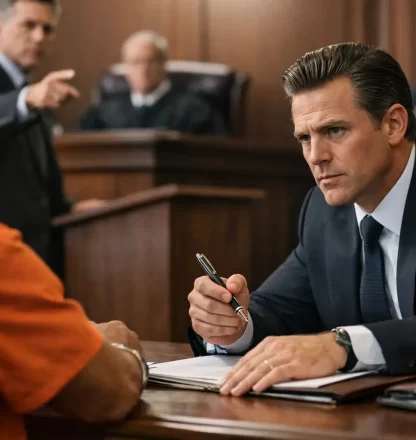
The state does not walk into court looking for a fair fight. Prosecutors come in with police reports, witnesses, lab results, and a story they want a jury to accept without too much resistance. A strong criminal trial defense strategy is built to disrupt that story, test every assumption, and force the government to prove its case the hard way.
That matters more than most people realize. Criminal charges are not just about whether you did something wrong. They are about what the state can actually prove, whether officers followed the law, whether witnesses are believable, and whether the evidence holds up under pressure. Trials are won and lost in those details.
What a criminal trial defense strategy really means
A criminal trial defense strategy is not a speech made at the end of a case. It is the full battle plan. It starts early, often before formal charges are even filed, and it shapes every move that follows. The right strategy can affect bond, pretrial motions, plea negotiations, jury selection, witness preparation, and what happens when a prosecutor tries to put on a polished case.
Good defense work is not passive. It does not sit back and wait to react. It looks for fractures in the prosecution’s timeline, motives to lie, sloppy police work, weak forensic assumptions, constitutional violations, and facts that do not fit the accusation. In some cases, the strongest move is to attack identification. In others, it is to challenge intent, expose a witness with an agenda, or keep damaging evidence out entirely.
The key point is simple: every case needs its own plan. A DUI trial is not defended the same way as a robbery charge. A drug trafficking allegation demands a different attack than a domestic violence accusation. Anyone promising a one-size-fits-all approach is not talking like a trial lawyer.
The prosecution has pressure points
Many defendants assume the state has the advantage because it has police, labs, and resources. That is true to a point. But prosecutors also carry a burden, and that burden creates openings. They have to prove guilt beyond a reasonable doubt. Not maybe. Not probably. Beyond a reasonable doubt.
That high standard changes everything. It means one unreliable witness can matter. One break in the chain of custody can matter. One illegal search can matter. One officer who wrote a careless report, exaggerated observations, or contradicted body camera footage can damage the entire case.
An effective criminal trial defense strategy identifies those pressure points early and keeps pushing on them. If the state’s case depends on a shaky eyewitness, the defense should make that witness uncomfortable with the truth. If the prosecution relies on a confession, the defense should test whether it was lawfully obtained and whether it was accurate, voluntary, or taken out of context. If the charge depends on intent, the defense should force the state to prove what was in a person’s mind, not just what happened on the surface.
The strongest trial defenses are built long before trial
People hear the word trial and think about the courtroom. Real trial preparation begins long before a jury is sworn. It begins with investigation.
That means reviewing the charging documents, police reports, dispatch records, body camera footage, surveillance video, phone data, forensic reports, witness statements, and prior inconsistent statements. It may require visiting the scene, locating defense witnesses, preserving digital evidence, and retaining experts. In serious felony cases, this work can be the difference between a defense that controls the case and a defense that gets buried by it.
Pretrial motions are also part of the fight. A motion to suppress can take out evidence obtained through an illegal stop, search, or interrogation. A motion in limine can limit what a jury hears. A demand for discovery can expose weaknesses the state would rather gloss over. These are not technical side issues. They are battlefield moves.
Sometimes the best result comes from pressure created before trial. When the defense exposes fatal weaknesses, the prosecution may reduce charges, offer a more reasonable resolution, or rethink whether the case is worth trying. But that leverage usually comes from credible trial readiness. Prosecutors can tell the difference between a lawyer who is posturing and one who is prepared to fight in front of a jury.
Witnesses often decide the case
Trials are rarely about paper alone. They are about people. Jurors watch faces, tone, hesitation, overconfidence, memory gaps, and evasive answers. That is why witness examination is one of the most dangerous weapons in a defense lawyer’s hands.
Cross-examination is not about theatrics for their own sake. It is about control. A disciplined cross can expose contradictions, bias, poor perception, bad memory, and outright dishonesty. It can show that a witness never had a clear view, made assumptions, changed a story, or had something to gain by accusing someone else.
Police witnesses also have to be tested. Jurors may initially give officers the benefit of the doubt, but that does not make their testimony untouchable. Officers can miss details, jump to conclusions, rely on bad identifications, or perform unconstitutional searches. When a defense lawyer knows the reports better than the witness does, the state loses ground fast.
Defense witnesses require strategy too. Not every witness helps. Some sound good in theory but fall apart under cross-examination. Others open doors that should stay closed. Part of a smart defense is knowing when to call a witness, when to hold back, and when the prosecution has already failed without needing help from the defense table.
Juries do not decide cases like lawyers do
A case can look weak on paper and still create risk in front of a jury. It can also look dramatic in an arrest affidavit and collapse once real people hear it in open court. Jurors bring common sense, emotion, skepticism, and life experience into the room. They do not process evidence the same way lawyers do.
That is why jury selection matters. The goal is not to find people who “like” the defense. The goal is to identify people who can be fair, who understand the presumption of innocence, and who will hold the state to its burden instead of expecting the accused to prove anything.
Theme matters too. Jurors need a clear framework for understanding the case. Sometimes that theme is mistaken identity. Sometimes it is a rushed investigation. Sometimes it is overcharging by the state. Sometimes it is self-defense, lack of intent, or unreliable science. The wrong theme confuses people. The right one gives jurors a reason to doubt the prosecution from opening statement through deliberations.
When the facts are difficult, strategy matters even more
Not every case comes with clean facts. Some defendants made bad decisions. Some were in the wrong place at the wrong time. Some said things they should not have said. Some cases involve ugly allegations that trigger strong reactions before the evidence is even tested.
That does not mean the case is lost. It means the defense has to be sharper. In hard cases, strategy may focus on reducing the scope of the accusation, separating emotion from proof, challenging overreach, or contesting a specific legal element the state cannot fully establish. A charge can be serious without being provable as filed.
This is where discipline matters. Panic is not a strategy. Wishful thinking is not a strategy. Waiting to see what happens is definitely not a strategy. The defense has to make decisions based on evidence, law, witness behavior, and how real jurors are likely to respond. Sometimes the right move is aggressive motion practice. Sometimes it is a targeted trial presentation. Sometimes it is using trial readiness to force a better outcome short of verdict. It depends on the case, and honest counsel should say that.
Choosing a lawyer who can actually try the case
If your freedom, record, license, or reputation is on the line, you do not need a caretaker. You need someone who can put the state on defense. That means a lawyer who prepares thoroughly, attacks weak evidence, handles witnesses with force and precision, and does not shrink when the courtroom pressure rises.
A real trial lawyer understands that prosecutors negotiate differently when they know the defense is dangerous in front of a jury. That reputation matters. So does presence. So does the ability to think fast when testimony changes, a ruling comes down unexpectedly, or the state overplays its hand.
At The Law Offices of Julian M. Kessel, that trial mindset is central. Serious charges call for serious resistance, not timid file shuffling.
If you are facing criminal charges, the right question is not whether the accusation sounds bad. The right question is whether the state’s case can survive a disciplined, aggressive attack. That is where strategy begins, and for many people, it is where hope returns.